Friday, December 19, 2014

Chemical Bonds by Jesse

Definition-Two or more atoms that are combined to form a chemical substance. This is caused by the force of attraction by opposite charges between electrons and protons.

Types of bonds-Ionic and covalent.
Ionic bonds form when one or more electrons is transferred to another atom and form ions. The ions than attract because one is negative (anion) and one is positive (cation). Ionic compounds are made up of a large number of ions, both positive and negative, so that the positive charge equals the negative charge. Salt (NaCl) is an ionic bond.
Covalent bonds form when atom needs one or more electrons but the other atom also needs them. To deal with this the electron(s) are shared between the two atoms causing them to bond. A molecule is a group atoms that are bonded together by covalent bonds. Water (H2O) is a covalent bond.

Importance
            Chemical bonds are important because they can take two or more elements and combine them into almost a completely different substance. Salt (NaCl) is made up of two poisonous elements, sodium and chlorine, but is a completely safe edible compound. 

visual


Green electrons are shared

Question
Which bond do you think is stronger or if they are just as strong as eachother?

Experiment by Bryce

Summary- I did an experiment seeing which shape of ice would melt faster and slower. In the research I found the melting rate is directly related to the surface area in comparison to the volume. The more surface area there is the faster the ice will melt due to more amount of area exposed to the heat. To prove this idea I made 3 different ice shapes and did three different tests of each shape. The first shape I did was a crescent shape. This was the shape that was expected to last longest, and in all three cases it did. The second shape and second longest lasting was the store bought cubed ice. The third and fastest melting shape was a ghost shape made by a jello mold. The crescent lasted the longest because it had a low surface area in comparison to the volume. The store bought ice had a hole in the middle of it and was round, but the hole made the surface area greater and not very dense, causing it to melt faster. The ghost shaped ice melted about thirty percent faster than the crescent because there was almost no volume to it, it was all surface area.

3 Facts-
1.    Ice is one of waters forms
2.    It is solid because the molecules are moving so slowly
3.    Round objects have less surface area than square flat objects


Why it’s important- This is important because everyone should know which shape of ice melts the slowest, so they can enjoy the ice in their drinks for longer in the summer. This could also help when it comes to cooking. Knowing that shapes heat up faster when the comparison of surface area to volume could be very helpful in the kitchen. 

Genetics by Michael

Genes are a huge part of heredity in living organisms. They are the molecules that form patterns and codes that translate to the physical traits that we receive from our parents. These physical features that are a product of heredity are called phenotypes. On the chromosomal level, your hereditary code is your genotype.

A genetic code can be thought of as a sentence. In the English language, a sentence is made up of words, and these words are made up of letters. In genetics, nucleotides are the letters. When put together they form “words” or genes. Cells read and translate these sentences of nucleotides to produce amino acid chains. These chains are proteins.

Interesting facts about genetics:

·         It takes about 8 hours for one of your cells to completely copy its DNA.
·         Human DNA is 98% identical to chimpanzee DNA
·         It would take 57 years to recite all of your ATCGs at 100 per minute.
·         If you stretched out the DNA from your 46 chromosomes in one cell, it would be over 2 yards long.
·         1 in 180 babies are born with a chromosome abnormality.

Why are genes important?


Without genes, everyone would be the same. There would be no uniqueness in the world. People would all look the same and have the features. Also, without genetics, there would be no evolution. If there was no way to change throughout generations, there would be no way for living organisms to evolve to their environment. 


Thursday, December 18, 2014

Self-propelled vehicle video by Jessyka

We had a student absent for the derby in September, so she taped a video of her self-propelled vehicle. Here it is:

https://www.youtube.com/watch?v=7utQ1qgVXF4

DNA by Hannah

DNA stands for Deoxyribonucleic Acid. It is the genetic material in all living things that makes up their genes. Multiple scientists – Fredrick Griffith, Oswald Avery, Alfred Hershey, and Martha Case – discovered that DNA was in fact the hereditary material and not protein, which was widely accepted at the time. The structure of DNA, however, was still unknown. Some key figures in the discovery of the structure of DNA were Rosalind Franklin, Erwin Chargaff, and Watson and Crick. The combination of all their experiments results in the structure of DNA. They discovered that the structure of the molecule is a double helix and the sugar-phosphate strands are held together by nucleotides. 


Each nucleotide has three parts: deoxyribose, a phosphate (PO4) group, and an organic base. There are four different kinds of bases: Adenine, Thymine, Guanine, and Cytosine. These bases are split in two groups: purines and pyrimidines. The purines, or larger bases, are Adenine and Guanine. The pyrimidines, or smaller bases, are Thymine and Cytosine. Chargaff’s rules states that DNA molecules always have equal amounts of pyrimidines and purines. The bases are always paired with each other in the same way as well (A = T, & G = C). Hydrogen bonds are then formed between the base pairs. 

DNA copies itself through a process called DNA Replication. During this process, the DNA strands unwind, an enzyme primes the strand for replication, another enzyme builds the strands, and then the new strands are rewound. The enzymes involved in this process are helicase (unwinds strands), DNA polymerase III (adds complementary nucleotides to the strands), primase (synthesizes a primer to begin the construction of the new strand), DNA polymerase I (removes primer and fills in the gap left), and DNA ligase (joins the ends of the newly synthesized segments of DNA). During the process of DNA replication mistakes can occur. These mistakes are called mutations. A mutation is a change in the content of the genetic message. A recombination is a change in position of a portion of the genetic message.


It is very important that we know about DNA for multiple reasons. First, so we can better understand the causes of some diseases and create better preventative medicines. Next, it is important to know how a disease is passed on in order to trace it or predict the chances of someone having it. It is also important to know how our DNA may be affected by certain environmental factors, or how our choices could affect our children’s DNA. How much more do you think future generations will know about DNA than we do now? Do you think there will be more mutations? Why?

Here are a few interesting facts about DNA:
·         “Every human being shares 99% of their DNA with every other human.”
·         “If you put all the DNA molecules in your body end to end, the DNA would reach from the Earth to the Sun and back over 600 times.”
·         “DNA is found inside every cell in our body (apart from red blood cells), and each cell contains roughly 2 meters of DNA.”

Wednesday, December 17, 2014

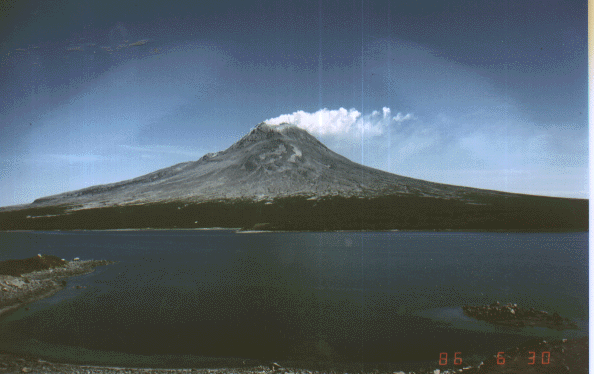
Volcanoes by Scott

Definition: “A vent in the earth's crust through which lava, steam, ashes, etc., are expelled, either continuously or at irregular intervals.”
-       Facts:

§  The Ring of Fire, located in the Pacific Ocean, has over 75% of Earth’s volcanoes

§  Volcanoes are usually formed on tectonic plates
§  Mantle plumes are volcanoes formed by hot spots and are located away from the tectonic boundary
§  When a volcano erupts it creates great farming soil
-       Magma
o   Definition: molten material beneath or within the earth's crust, from which igneous rock is formed.
-       Lava
o   The molten, fluid rock that issues from a volcano or volcanic vent.
-       Types of volcanoes
o   There are three main types
o   Shield
§  A broad volcano built up from the repeated nonexplosive eruption of basalt to form a low dome or shield, usually having a large caldera at the summit
§  Tend to have Low Silica Levels
§  Low viscosity levels
§  Has both High and Low gas levels
They are not that explosive


o   Composite (Stratovolcano)
§   A large, steep volcano built up of alternating layers of lava and ash or cinders.
§  High Silica levels
§  Highly viscous
§  High gas levels
Very explosive


o   Cinder cone
§  A small, conical volcano built of ash and cinders.
§  Low silica levels
§  High gas levels
§  Fountain eruptions


-       Viscosity
o   Definition: the property of a fluid that resists the force tending to cause the fluid to flow.
Lava has uses for farming, but does it have any other uses? Can we somehow harness the power of a volcano to provide heating for homes?


Tuesday, December 16, 2014

Electromagnets by Steven

Well they work by electric charges that are vibrating. These waves carry energy from one place to another. They don’t require matter to move energy unlike sound waves and water waves. These waves can travel anywhere, even where matter isn’t present. They transfer energy from electric to magnetic fields. Just like magnets electricity has its own field around it. This is called an electric field. The energy carried by an electromagnetic wave is called radiant energy.

Electromagnetic waves are everywhere surrounding us right now. Without them we couldn’t do anything. Since the radiant energy is being transferred this also allows us to feel warmth from a fire and allows us to see.

Monday, December 15, 2014

Vitamins by Zach

Summary:
During this topic the class did a variety of presentations that taught about the effects of each vitamin, amount of each vitamin needed to survive, and how each vitamin travels through the body. We learned about the deficiency and toxicity levels of vitamins and what happens when those levels are reached.

Interesting Facts:
            An interesting fact that the class learned was that a majority of the vitamins found in the human body come from fruits, including:
            *Peaches
            *Kiwi
            *Strawberries
            Another interesting fact that the class learned about during this topic was that Vitamin E causes a degeneration of the central nervous system and peripheral nerves and a an accelerated destruction of red blood cells at a toxic level. The toxic level of Vitamin E for people under the age of 14 is 8 or more mg and for people over the age of 14 is 16 or more mg.
            The third interesting fact that we learned from this topic was that fish such as salmon and sardines are a great source of Vitamin D. Sardines give your body 70% of its daily requirement of Vitamin D. Salmon holds 90% of the daily requirement of Vitamin D needed in your body.

Why is this Important?
            This topic is important because it teaches us the requirements of each vitamin needed in our body so that we do not die due to deficiency or toxicity from each vitamin. It is important to know the symptoms of deficiency and toxicity so that if those things happen to you you know what to do.

Questions:
     What are some of the most common vitamins found in your body?
     What is the most common source of Vitamin D?

Visual:

            Deficient levels of Vitamin A worldwide.


Thursday, December 11, 2014

Mitosis and Cell Reproduction by Luke


Mitosis is the process of cell division. It is important to know about Mitosis because this is how the cells are replaced in your body. If cells didn’t go through mitosis organisms would not grow or heal. Mitosis has four phases, after all the phases are completed the cytokinesis takes place. Cytokinesis is when the two cells’ cytoplasm separates and they finally become two separate cells.

In a life of a cell Mitosis is a rather small part of their lives but some cells can go through mitosis for sixteen years. During the other parts of the cell’s life, the cell does its regular functions and prepares for mitosis by growing in size and creating DNA

Before Cytokinesis happens the cell must undergo the four phases. The first phase is Prophase, in Prophase the nuclear membrane dissolves and spindle fibers form. If you look at a cell in Prophase you can see the individual chromosomes.

The second phase is Metaphase. During Metaphase the original and the copied chromosomes line up in the middle of the cell. Once they line up the spindle fibers connect to the chromosomes. This step is crucial because the chromosomes must be even so that the new cell is not mutated.

The third phase is anaphase. When the cell goes through anaphase the centromeres holding the chromosomes together break apart. Then the chromatids move to opposite sides of the cell. This phase is when the cells basically start separating

Last but not least the cells must undergo Telophase. Telophase is the phase where the cells begin forming their own nuclear membrane, also the spindle fibers begin to break down and the chromosomes uncoil.

Before a cell starts mitosis the original cell checks to see if it is prepared to split, this ensures that a new cell is perfectly formed. Lets say that if a cell goes through mitosis incorrectly, what happens then? When a incorrectly cell is made, the bad cell multiplies itself many times. As an audience, try and figure out what can happen to an organism that has bad cells that constantly reproducing.

Mitosis is the most important key for cells to reproduce because if they go through a stage wrong bad things can happen, but if it goes through mitosis like it is suppose to do, the organism can grow and be successful.  

Cell Transport by Michael

Transportation between cells can happen in three different ways. There is active transport, and passive transport. In passive transport you have Diffusion and Facilitated Diffusion.
            In active transport, a molecule requires energy from the cell to enter and leave the cell. It is required when moving a molecule. It’s when the molecule moves against the grain. This means that they move from an area of low concentration to an area of high concentration. For example, if you sprayed perfume in two corners of a room, through active transport, the amount that you sprayed less of would go straight towards where there is more perfume.

            Diffusion is a form of passive transport. It occurs when a molecule moves from an area of high concentration to an area of low concentration. It spreads out to make all of the room in a cell evenly distributed. Osmosis is the diffusion of water through a membrane.


            Facilitated diffusion is when diffusion needs to be helped. It moves molecules and ions through specific transmembranes. It makes some things easier to pass through the membrane. Some things that need this are glucose, sodium, and chloride ions need to have facilitated diffusion to pass through the membrane.